
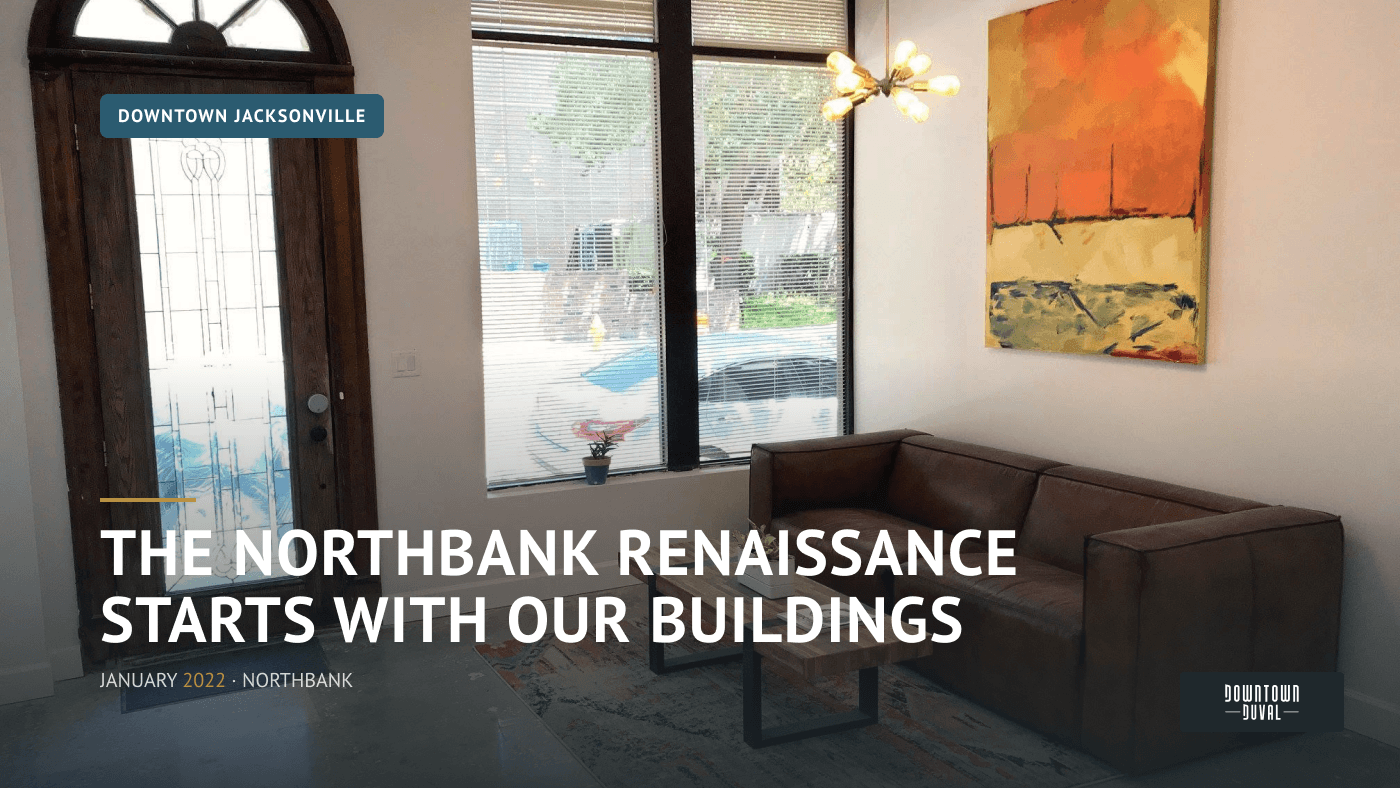
If you have spent any real time in downtown Jacksonville, you know the feeling. One block gives you a handsome old facade, a working corner business and a glimpse of what the city used to be. The next gives you a surface parking lot where you find yourself imagining what could be there instead.
Jacksonville’s downtown story has always contained a little of both. Ambition and loss. Great architecture and missed opportunities. Beautiful streets that deserve more people walking them.
That is why 2022 is shaping up to be an interesting turning point for the Northbank. Not because one magical project promised to fix the city, but because people were finally paying attention to something we had been walking past for years: the buildings we already have.
A different kind of downtown comeback
This month, local urbanists Ennis Davis and Bill Delaney, whose work began with Metro Jacksonville and continues through The Jaxson, are documenting a wave of adaptive reuse projects in the heart of the Northbank. In their January 11 report for Jacksonville Today, they point to at least 14 significant projects that moved forward by the end of 2021, with more joining the conversation.
The striking thing isn’t only the number of projects. It is their proximity to one another around James Weldon Johnson Park, along streets where a person can walk from one building to the next in minutes.
Older properties are being considered for apartments, offices, restaurants and gathering spaces. Projects involving the historic Federal Reserve Bank, the Florida Baptist Convention Building, and the Jones Brothers Furniture Building are helping put an old idea back in fashion: sometimes the most promising building site is a building that’s already standing.
These are proposals and projects at different stages, not a list of openings. But they represent a meaningful change in how Jacksonville is talking about its downtown.
Why preserving a building is about more than nostalgia
A restored historic building preserves a piece of architecture. Just as importantly, it preserves something less obvious: the street around it.
Think about the difference between walking along a block lined with windows, doors and occupied ground floors, and crossing an empty block bordered by parking lots. The first gives you reasons to look around and maybe stop. The second gives you reasons to keep moving.
That is why adaptive reuse matters so much on the Northbank. Buildings such as the old Federal Reserve Bank and the Florida Baptist Convention Building connect the neighborhood’s history to potential future uses. They also help maintain the texture of streets where people once did their banking, shopped for furniture, worked in offices and met friends downtown.
The Downtown Investment Authority’s preservation and revitalization program reflects this larger purpose: bringing underused buildings back into productive life while reinforcing downtown as a place for business, history, culture and entertainment.
There is an economic argument here, too. An existing building can give a small firm, nonprofit or independent business an address with character, without requiring a new tower to be built first. Reuse is not always easy or inexpensive, but it gives the city an opportunity to work with what it already has.
The Northbank works best one block at a time
The Jaxson has long made a persuasive point about downtown revitalization: destinations become more powerful when they are clustered close enough for people to walk between them. In its look ahead at the urban core in 2022, the publication connects new development to the larger comeback of Jacksonville’s older neighborhoods.
We see the wisdom of that idea from Newnan Street. Within a compact stretch of downtown, the Florida Theatre, James Weldon Johnson Park, the Elbow’s restaurants and bars, office buildings and the St. Johns River can all be part of one visit.
A lively downtown is not just a collection of destinations. It is what happens between them.
It is the coffee before a meeting, an art show after work, a walk to the river at lunch and the unexpected conversation that makes a neighborhood feel like a neighborhood. None of that appears as a single glamorous line item in a development budget. Collectively, it makes the difference.
History has a place in the future of work
Our own home at 10 South Newnan Street was built in 1910. We care about maintaining a working building with that history, while making it useful to the organizations and teams who need a place downtown today.
That doesn’t mean every building should become a museum or that every new development should look old. It means the best next chapter for Jacksonville can include both beautiful old places and thoughtful new ones.
The Northbank needs residents. It needs good restaurants and neighborhood services. It needs public spaces where people want to linger. And it needs people working in the buildings between them, especially the small businesses and nonprofits that make a downtown feel personal.
What comes next
Not every project on today’s list will follow its original schedule or design. That is part of the honest story of a city in transition. But the lesson is already clear: preserving and reusing existing buildings can help create a more connected neighborhood, especially when those buildings sit near other active places.
The next time you are downtown, try a different route. Turn off the main road. Look up at the windows above the storefronts. Notice the details that have survived generations of change. Downtown Jacksonville isn’t starting from scratch, and that is one of its greatest advantages.
We are proud to be part of that story at Downtown Duval, where historic character and modern office space meet on the Northbank. If you’re curious about the building or want to explore working downtown, come see it for yourself.
Looking for office space in downtown Jacksonville? The Downtown Duval Building at 10 South Newnan Street offers flexible private offices in a historic 1910 building, from $850/month with utilities and shared fiber internet included. Tenants share a kitchen, billiard lounge and an 893 SF second-floor deck, with on-site parking available separately. See available offices or schedule a tour.